Is Everything Forgivable?
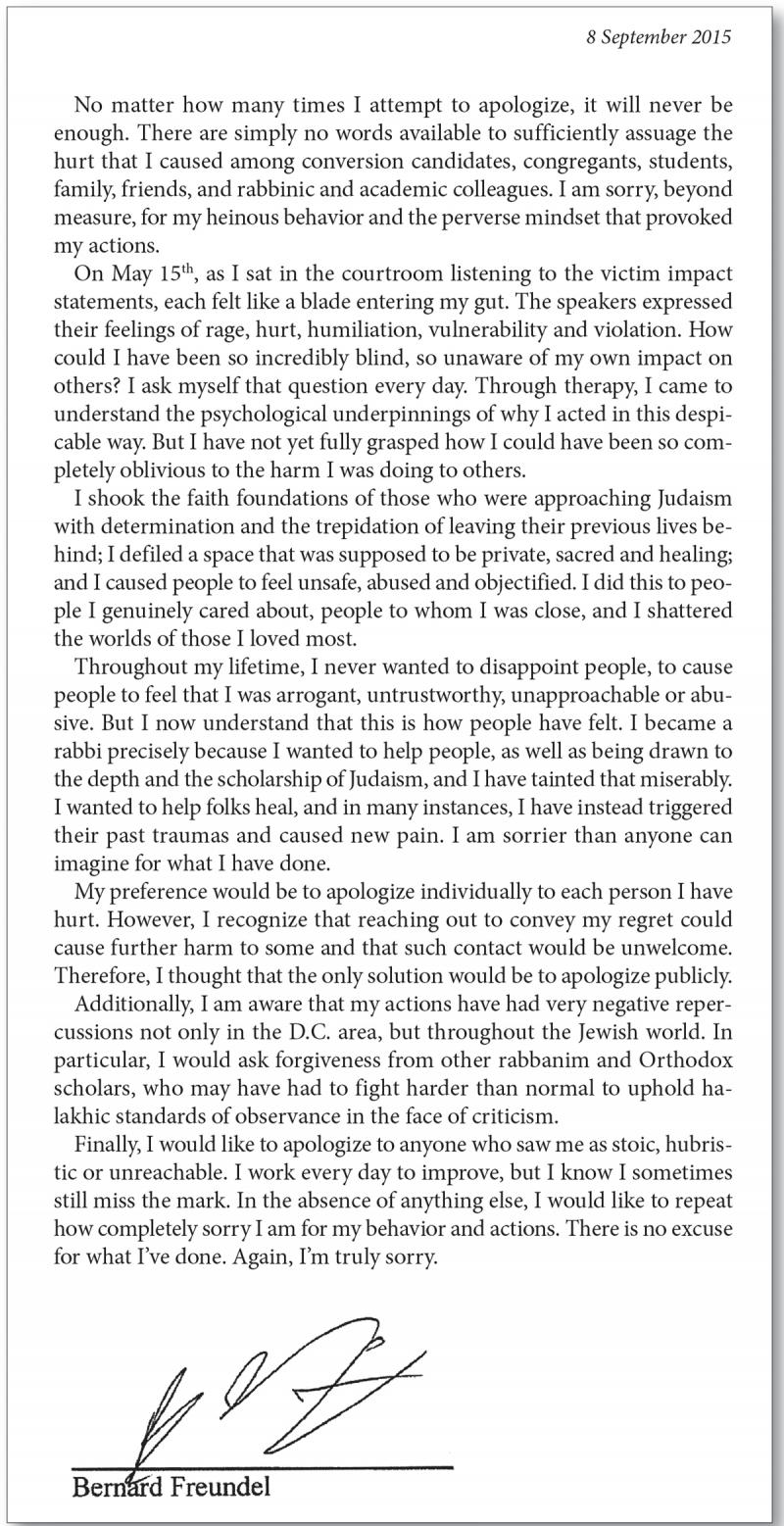
“No matter how many times I attempt to apologize, it will never be enough. There are simply no words available to sufficiently assuage the hurt that I caused among conversion candidates, congregants, students, family, friends, and rabbinic and academic colleagues. I am sorry, beyond measure, for my heinous behavior and perverse mindset that provoked my actions.”
These words were penned this week in a public letter* of apology by a disgraced rabbi who pleaded guilty to secretly videotaping fifty-two women and was sentenced to six and a half years in prison. One of his victims said she is “torn on the apology… I don’t think we would be seeing this had he not been caught. It’s hard to take it seriously when he’s making the apology after the fact.”
Who could blame or judge this victim or any other for struggling with granting forgiveness to a perpetrator who caused them immeasurable and unimaginable pain? It takes time to heal from the trauma of being violated and similarly it takes time to find the capacity for forgiveness, if it can be found at all.
In his bestselling book “The Sunflower,” Simon Wiesenthal recounts his work camp experience of being brought to a dying Nazi soldier’s bedside. The man turned to Wiesenthal and confessed his crimes and horrific wrongdoings against the Jewish people. He then asked Wiesenthal to serve as a representative of all his victims and begged forgiveness. Wiesenthal describes that he could not grant the soldier his wish because some things are simply too heinous and atrocious to forgive. Wiesenthal describes that the rest of his life, he remained tortured by that request and by his reaction to it.
Are there indeed things that are unforgivable? Or, does every sincere, genuine, remorseful appeal for forgiveness deserve to be granted? Victims of unthinkable heinous acts undoubtedly struggle with this question for the rest of their lives. Those that have never walked in their shoes cannot and should not judge the conclusion they reach.
For survivors of the Holocaust or victims of enormous abuse like being physically violated as a child or adult, or videotaped in a Mikvah, granting forgiveness is tremendously complicated. However, when it comes to the everyday slights, snubs, insults and offenses, granting forgiveness is even more valuable and important for us than it is for the one requesting it.

Our rabbis teach: “Kol ha’maavir al midosav, ma’avirin lo kol p’shaav – who is forgiving, God is forgiving of them.” (Rosh Hashana 17a) Too many of us are accountants, not by training or trade, but in practice. We are constantly balancing the books of our relationships with others. “We invited them 3 times and they only invited us once,” or “they didn’t give my son a bar mitzvah gift even though they attended, so I am not giving their child a gift either.” “I am always calling him or asking to go to lunch, he never initiates so I am done with this friendship.” “Would you believe he walked right by me in Shul and shook hands with someone else without even acknowledging my presence. Forget him, our friendship is over.”
With family, the accounting is often more detailed – “I always call her on her birthday, she didn’t call me this year so I am not talking to her.” “I can’t believe they sat me at the table with those cousins and not with the people I wanted to sit with.” “Three years ago, we didn’t get a card for our anniversary so we are no longer sending them cards.”
“Kol ha’maavir al midosav, ma’avirin lo kol p’shaav.” With this statement the Talmud provides the formula for receiving forgiveness from the Heavenly court. God, say our rabbis, approaches us with the same attitude and philosophy we approach the people in our lives. He judges us with a mirror. If we are exacting, accounting and unforgiving to those around us, He is exacting, accounting and unforgiving of us. If we instead choose to dismiss, minimize and ignore the slights, snubs and slurs that people have perpetrated against us, then Hashem chooses to dismiss and ignore our slights and snubs of Him.
I don’t believe that the Talmud is referring to Wiesenthal’s conundrum, which is of a different magnitude and order. Perhaps there are violations that the Ribonno Shel Olam Himself cannot expect the victims to forgive and certainly not forget. However, when it comes to the petty affronts and offensives that are committed against us sometimes as often as daily or weekly, it is in our own self-interest to find a way to grant forgiveness when it is sincerely sought and sometimes, even when it isn’t.
When we walk around with the accounting books and keep track of everything everyone around us has done that is hurtful both intentionally and unintentionally, the one who suffers the most is ourselves. Authentic forgiveness is not only about the perpetrator of the act and absolving him or her of their misdeed. Forgiveness is for the victim, the one who has been hurt or harmed. It is exhausting, burdensome, even paralyzing to carry and harbor negative feelings and negative memories.
This is the season to let go. A professor once held up a beaker filled with water before a class and asked how much they think it weighs. One student said two ounces, another though six ounces, another two pounds. The professor looked at the class and said they are all right. How could they all be right, asked the students, aren’t they saying different things? The professor answered, they are all right, it just depends how long I hold onto it.
When our grudge is formed, it seems somewhat light, small, and insignificant so it is easy enough to carry around with us. The longer we hold onto it, however, the heavier it becomes and the greater the energy, effort, and focus necessary to carry it forward. It is time to let go, to be willing to forgive and forego, even that which is due to us.
Indeed, it is only when we have the capacity to let go, to move on, to not absorb the negativity and toxicity of a strained relationship, to be a forgiving person, that we have the capacity for greatness. The Rambam identifies as one of the defining characteristics of a Talmid Chacham that one must be a mevateir, a forgoer, one who is forgiving and does not hold a grudge.
As we enter Rosh Hashana and Yom Kippur, now is the time to decide to be a mevaitair, to transform ourselves into the kind of people who let things go. I can tell you with certainty the Almighty loves amevateir. Don’t be concerned with rights, honors, privileges, and entitlements. Don’t focus on what we are due and what the people who hurt us deserve. Put down the heavy baggage, let go and forgive, and you will live life so much lighter.
Source: Rabbi Efrem Goldberg