Thus saith the LORD of hosts: In those days it shall come to pass, that ten men shall take hold, out of all the languages of the nations, shall even take hold of the skirt of him that is a Jew, saying: We will go with you, for we have heard that God is with you.
This blog's been flagged because it includes content that "other people" on Facebook have reported as abusive. Share B"H
Christian, what are you going to say to G-d of Israel when your god Jesus doesn’t return?
Worshiper of Jesus, Christian/Messianic, what are you going to say when you stand before G-d after the false man-god Jesus whom you worship and to whom you pray doesn’t appear? What are you going to say to your Maker when you knew all along (and I am merely reminding you here now) that worshiping anyone or anything other than Him is a grave sin and betrayal? How will you justify your worship of a mortal creature to whom billions bow their knees? Will you deny that you knew that He has warned you that He was neither a man nor a son of man (Numbers 23:19), that He had no visible form and that He can’t be compared to anything He created? Will you try to defend yourself that you only followed your leaders or will you admit to G-d your sin of idolatry? Will you appeal to the polished literary character from the pages of your New Testament? Will you tell G-d that Jesus paid for your sins by his blood when He explicitly warned that He doesn’t approve of human sacrifices (Leviticus 18:21 and Deuteronomy 12:31) and that no man can punished for the sins of another (Ezekiel 18:20)? Will you point to the [Greek] Testament in your defense and claim it to be the “word of G-d”? Will you claim that you have put your faith in Jesus, Paul, apostles, the church scribes, church fathers, pastors and evangelists? Will you attempt to boldly walk into the Holy of Holies as the author of Hebrews exhorts you to do (Hebrews 10:19) and demand to be allowed in since you placed your trust in a “son of man”, despite the fact that G-d has told us in Numbers 23:19 not to do just that? What will come out of your mouth? Do you know?
The Bible already knows what you are going to say. Indeed, it gives us a glimpse of your very words and it tells us in the Jewish scriptures, the writings that you call “the Old Testament”, the words all of the nations will utter before the G-d of Israel in the end of days:
“To you (Hashem) shall the nations come from the ends of the earth and say: “Our fathers have inherited nothing but lies, worthless things in which there is no profit. Do people make their own gods? Yes, but they are not gods!” (Jeremiah 16:19-20)
Today, however, the choice is still yours. Today, you can still either choose to continue worshiping Jesus as you god, to proclaim him as your “lord and savior” or you can choose to discard your idolatry and turn to the living G-d of Israel and Him alone. Make no mistake – you DO have a choice whom you will serve – if a man Jesus whom Christianity has deified to seat him on G-d’s throne is your ba’al (Hebrew word for “lord”), serve him. But if the G-d of Israel is the L-rd, then you know what you need to do. If you choose idolatry over the Living G-d of Israel, do not think that there is safety in the great numbers among the nations that Christianity and other religions can boast. As G-d said:
“Before Him all the nations are as nothing; they are regarded by Him as worthless and less than nothing. To whom, then, will you compare G-d? What image will you compare him to?” (Isaiah 40:17-18)
A reposting of Uri Yosef’s THE "LAST AND FINAL SACRIFICE" TAKES THE TEN-COUNT after a Christian apologist made
this comment recently. May it be a light to anyone seeking the G-d of Abraham, Isaac
and Jacob.
“The reason Jews as a
whole haven't embraced Jesus Christ as Messiah is partly because of hard
hearts, and partly because Jesus came to die for our sins. It was foreseen by
God the Father that He would be rejected, per Isaiah 53 - which Jews have NEVER
been able to "explain" - which then paved the way for His
once-for-all sacrifice for sin.”
A KNOCK-OUT PUNCH:THE "LAST AND FINAL SACRIFICE" TAKES THE TEN-COUNT
Professor Uri Yosef
I. INTRODUCTION
Christian missionaries claim that those who do not accept Jesus as their lord and
savior, which includes the Jewish people, are doomed to burn in “hell” because
they cannot have their sins forgiven by God. This claim is rationalized with the
allegation that, in Biblical times, the only way to bring about the remission of sins
was via the blood of a certain animal. This animal had to be brought to the priest
to be slaughtered at the altar in the Sanctuary, first while in the portable
Sanctuary and later in the Temple, as a sacrificial offering. According to this
claim, since there has been no Temple standing in Jerusalem since the year 70
C.E., valid sacrificial offerings can no longer be made and, therefore, the only
way for Jews to have their sins forgiven is through the blood shed by Jesus in his
"sacrificial" death on the cross. In other words, the claim is that the blood of
Jesus, who was allegedly sacrificed by God (the "Father") as a demonstration of
his great love for mankind,
has once and for all removed the stain of “Original
Sin" from those who follow Jesus (the "Son"). This act of love by God allegedly
made Jesus the "last and final sacrifice" forever.
There are two main aspects to the claim that Jesus was "the last and final
sacrifice". The first concerns the suitability of Jesus and his death as a sacrificial
offering for the remission of sins. The second aspect, which was investigated in
another essay, concerns the need for blood in the atonement process.
This essay examines the suitability of Jesus and the manner in which he died as
a sacrificial offering for the remission of sins.
II. THE CHRISTIAN PERSPECTIVE VERSUS THE SPECIFICATIONS IN THE HEBREW BIBLE
The process for testing this claim by Christian missionaries consists of
contrasting the requirements concerning sacrificial offerings, as specified in the
Hebrew Bible, against the accounts in the New Testament that describe the
death of Jesus on the cross as a sacrificial offering. As part of this analysis, it is
important to bear in mind the following two conditions that existed during the life
of Jesus, at the time of his death, and for several decades following his death:
The Second Temple was still standing in Jerusalem
The Hebrew Bible was the Scripture in force
The salient issue to be addressed, and answered, is:
According to the requirements set forth in the Hebrew Bible, was Jesus a valid sacrificial
offering, and was his death by crucifixion an acceptable process, for remission of sins?
The analytical phase of the testing process identifies ten elements for which the
respective accounts in the New Testament are compared with the specifications
provided in the Hebrew Bible, primarily in the Torah.
One
According to the accounts in the New Testament, Jesus was crucified by
Roman soldiers:
John 19:18,23(KJV) – (18) Where they crucified him, and two other with him, on either
side one, and Jesus in the midst.
(23) Then the soldiers, when they had crucified Jesus, took his garments, and made
four parts, to every soldier a part; and also his coat: now the coat was without seam,
woven from the top throughout. [See also Matthew 27:35; Mark 15:24; Luke 23:33.]
According to the Levitical Law of Sacrifice in the Torah, the animal brought as
a sin sacrifice had to be slaughtered by the person who offered it:
Leviticus 4:27-29 - (27) And if any one person from among the common people sins
unwittingly, by performing one of the commandments of the Lord which may not be
done, and incurs guilt; (28) Or if his sin, which he has committed, is made known to
him, then he shall bring his sacrifice, an unblemished female goat, for his sin which he
has sinned. (29) And he shall lay his hand upon the head of the sin offering, and he
shall slaughter the sin offering in the place of the burnt offering.
Two
According to the Levitical Law of Sacrifice in the Torah, some of the blood of
the (sin) sacrifice had to be rubbed by the priest with his finger on the horns of
the altar in the Temple, and the rest had to be poured out at the base of the
sacrificial altar. The fat of the sacrifice had to be removed and burnt:
Leviticus 4:30-31 - (30) And the priest shall take some of its blood with his finger, and
put [it] upon the horns of the altar [used] for the burnt offering; and [then] he shall
pour out all of [the rest of] its blood at the base of the altar. (31) And he shall remove
all of its fat, as was removed the fat from the sacrificial peace offerings; and the priest
shall burn it upon the altar for a pleasant fragrance to the Lord; and [thus] shall the
priest make an atonement for him, and he shall be forgiven.
The New Testament is silent on what was done with the blood of Jesus and
with the fat of his body.
Three
According to the accounts in the New Testament, Jesus was beaten,
whipped, and dragged on the ground before being crucified:
Matthew 26:67(KJV) - Then did they spit in his face, and buffeted him; and others
smote him with the palms of their hands, [See also Mark 14:65; Luke 22:63; John 18:22.]
Matthew 27:26,30-31(KJV) – (26)Then released he Barabbas unto them: and when he
had scourged Jesus, he delivered him to be crucified.
(30) And they spit upon him, and took the reed, and smote him on the head. (31) And
after that they had mocked him, they took the robe off from him, and put his own
raiment on him, and led him away to crucify him. [See also Mark 15:15-20; John 19:1-3.]
According to the Torah, a sacrificial animal had to be without any physical
defects or blemishes:
Deuteronomy 17:1 - You shall not sacrifice to the Lord your God an ox or a sheep that
has in it a blemish or any bad thing, for that is an abomination to the Lord, your God.
Sidebar Note: As a born Jew, Jesus was circumcised on the eighth day following
his birth, a ritual that leaves a scar (Genesis 17:10-13; the “sign of the covenant”).
The circumcision of Jesus is mentioned in the New Testament (Luke 2:21), yet Paul
refers to circumcision as being tantamount to mutilation (Galatians 5:11-12;
Philippians 3:2).
Four
According to the New Testament, Jesus was "the Lamb of God" whose bones
may not be broken [a reference to the Paschal Lamb of Exodus 12:46 and
Numbers 9:12]:
John 1:29(KJV) – The next day John seeth Jesus coming unto him, and saith, Behold
the Lamb of God, which taketh away the sin of the world.
John 19:36(KJV) - For these things were done, that the scripture should be fulfilled, A
bone of him shall not be broken.
According to the Torah, the Paschal Lamb was not offered for the removal of
sins. Rather, it was a festive, or commemorative, offering. Yom Kippur (the
Day of Atonement) would have been a more appropriate time for a sin
offering:
Numbers 29:11 - One young male goat for a sin offering, beside the sin offering of
atonement, and the continual burnt offering, and its meal offering, and their drink
offerings. [Yom Kippur – Individual sin offering]
Leviticus 16:15 - He shall then slaughter the he goat of the people's sin offering and
bring its blood inside the dividing curtain, and he shall do with its blood as he did with
the blood of the bull and sprinkle it upon the cover of the ark, and before the cover of
the ark. [Yom Kippur – Communal sin offering]
Five
According to the Torah, the Paschal Lamb had to be slaughtered and its
blood used to place markings on the side-posts and lintels of the entrances to
the dwelling. Moreover, the meat had to be roasted and eaten, and whatever
was not consumed by the time the Israelites were to leave their homes, had
to be burnt and destroyed:
Exodus 12:6-10 - (6) And you shall keep it under watch until the fourteenth day of this
month; and the entire congregation of the community of Israel shall slaughter it at
dusk. (7) And they shall take [some] of its blood, and place it on the two doorposts and
on the lintel, on the houses in which they will eat it. (8) And they shall eat the meat in
that night, roasted over fire, and [with] unleavened bread; with bitter herbs they shall
eat it. (9) You shall not eat from it raw, nor boiled in water; but roasted over fire, its
head with its legs, and with its inner parts. (10) And you shall not leave any of it until
morning; and that which left over until the morning you shall burn in the fire.
According to the accounts in the New Testament this was not done with
Jesus after his death. In fact, Jesus was buried.
Matthew 27:57-60(KJV) – (57) When the even was come, there came a rich man of
Arimathaea, named Joseph, who also himself was Jesus' disciple: (58) He went to
Pilate, and begged the body of Jesus. Then Pilate commanded the body to be
delivered. (59) And when Joseph had taken the body, he wrapped it in a clean linen
cloth, (60) And laid it in his own new tomb, which he had hewn out in the rock: and he
rolled a great stone to the door of the sepulchre, and departed. [See also Mark 15:42-46;
Luke 23:50-53; John 19:38-42.]
Six
According to the New Testament, the death of Jesus was a sacrificial offering
that expiated the sins of mankind for all times:
Hebrews 10:10,18(KJV) – (10) By the which will we are sanctified through the offering
of the body of Jesus Christ once for all.
(18) Now where remission of these is, there is no more offering for sin. [See also
Romans 6:10; Hebrews 9:12.]
According to the Torah, the Passover (sin) sacrifice, a male-goat, had to be
offered on an individual (per household) basis, not as a communal offering:
Numbers 28:22 - And one young male goat for a sin offering, to make atonement for
you.
Seven
According to the New Testament, the death and blood of Jesus took care of
(almost) all sins:
Hebrews 9:22(KJV) – And almost all things are by the law purged with blood; and
without shedding of blood is no remission.
According to the Levitical Law of Sacrifice in the Torah, the sacrificial sin
offering brought atonement only for unintentional sins, except as noted in
Leviticus 5:1-6, 20-26[Leviticus 5:1-6, 6:1-7 in Christian Bibles]:
Numbers 15:27-31 - (27) And if a person sins inadvertently, then he shall offer a female
goat in its first year as a sin offering. (28) And the priest shall atone for the erring
person who sinned inadvertently before the Lord in order to make atonement on his
behalf; and it shall be forgiven him. (29) For the native born of the children of Israel
and the stranger who resides among them, one law shall apply to him who sins
inadvertently. (30) And the person who does anything presumptuously, whether he is a
native born or a stranger, that person blasphemes the Lord; and that person shall be
cut off from among his people. (31) Because he has scorned the word of the Lord, and
has violated his commandment; that person shall surely be cut off, for his iniquity is
upon him.
Eight
According to the New Testament, the death of Jesus brought about the
remission of sins yet uncommitted, and of sins of those yet to be born:
Hebrews 10:18(KJV) – Now where remission of these is, there is no more offering for
sin.
According to the Levitical Law of Sacrifice in the Torah, sacrifices could bring
atonement only for sins committed prior to the offering of the sacrifice. No
sacrifice was provided for the atonement of sins committed after the sacrifice
was offered and, thus, no sacrifice can bring atonement for sins of people
born after it was offered. This includes both טּאתָחַ (haTAT)], a sin offering,
described in Leviticus 4:1-5:13, and שׁםָאָ (aSHAM), a guilt offering,
described in Leviticus 5:14-26. Had there been, among the listed sacrifices,
even one kind of sin or guilt offering that could bring atonement for future
sins, the person who would have offered that particular sacrifice would not
have had to do so again for the rest of his life. Moreover, Yom Kippur (the
Day of Atonement), which is ordained by the Torah as an annual Holy Day
(Leviticus 16:29-34), would have had to be celebrated by the Israelites only
the very first time after the giving of the Torah at Mt. Sinai, had they used one
of those "super" sacrificial offerings that could atone for sins of the future.
The claim by the author of Hebrews, that there are no more sin offerings
required following the death of Jesus, is false for other reasons as well:
The Second Temple stood in Jerusalem for nearly 40 years following the death of
Jesus, during which time literally thousands of animals were offered as sacrifices
of all sorts, including sin and guilt offerings, as prescribed by the Torah.
The Hebrew Bible contains prophecies about the building of the Third Temple in
the messianic era, and of the resumption of the sacrificial system at that time. All
the types of sacrificial offerings described in the Hebrew Bible will be made on the
sacrificial altar [חַ בֵּזְמִ (mizBE'ah)] in the Temple, including both the טּאתָחַ and
שׁםָאָ sacrificial offerings. In other words, the sacrificial system, which has been
in a state of suspension since the year 70 C.E., when the Romans destroyed the
Second Temple, will be completely restored in the messianic era:
Ezekiel 43:21-22 - And you shall take the bull of the sin offering, and he [the priest]
shall burn it at the edge of the Temple, outside the Sanctuary. (22) And on the
second day you shall offer an unblemished he-goat for a sin offering, and they [the
priests] shall purify the altar as they purified it with the bull. [See also: Isaiah 56:7;
Over the years I’ve collected a lot of bibles. I have a Thompsons Chain Reference KJV that’s been with me for years. It’s been highlighted, underlined and filled with margin notes with my own chain references, back pages loaded with various proof texts from my Christian days.
The sect of Christianity I came from was very focused on bible studies and “truth” or so they said, when I look back I’ve wondered how could I have been so deceived, totally missing the writing in plain sight.
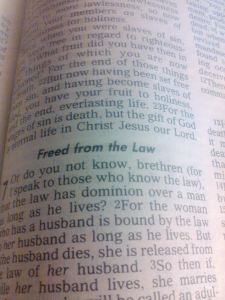
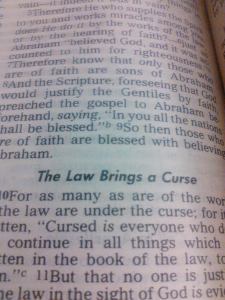
Looking through an old bible I noticed something I’d never questioned before, “the Headings” in select sections throughout the Christian bible chapters.
Christian mindset regarding ‘The Law’ (Torah)
The Christian view of “the Law” is also conveyed in “headings” found at the beginning of sections throughout Christian Bibles. These captions are placed there by the editors to help direct the reader as to what the next group of verses is concerned with.
For instance, at the beginning of the following sections in the “New Testament,” of a popular New King James version of the Bible, we find the following phrases:
Those under the Law of Moses were “under bondage,” which ended with Jesus
“No one could ever do everything the law requires”
The law was “a curse” that Jesus came to do away with. (1)
These three ideas may not be expressed in exactly the same words in every denomination, but the concepts are clear and present in the teachings of Protestant denominations and Catholicism.
On my drive to work in the mornings I’d listen to ‘Thru the Bible’ with J. Vernon McGee, “Thru the Bible program takes the listener through the entire Bible in just five years, threading back and forth between the Old and New Testaments.” Little did I know, my thinking was being shaped and directed in a theology that’s been crafted by the church for century’s. Here’s what Minister McGee wrote about the apostle Paul and the Jewish religion in his Bible commentary:
Paul now calls the religion in which he was brought up the ‘Jews’ religion.’ Paul was saved, not in Judaism, but from Judaism.” (Emphasized words are McGee’s) (2)
The same commentary regarding the book of Galatians states:
“Galatians has been called the Christian declaration of independence. It is Paul’s answer to those who challenged his authority as an apostle and who urged Christians in Galatia to live according to the Law of Moses. Adoption of the Jewish Law by Gentile Christians would have made Christianity merely a sect within Judaism. Paul taught that bondage to the Law ended when Christ made all men free.” (3)
In a commentary appendix to one version of the King James Bible, regarding the book of Hebrews, it says:
“With carefully reasoned arguments the author showed that Christianity is superior to Judaism,” … “Christianity is the perfect religion.” (end-of-quote)
Christian Bible headings, footnotes, commentary books, radio broadcasts and sermons from the pulpits have expressed this thought for centuries, maintaining that Christianity is G-d’s true religion.
Take the three ideas above and hold them up in light of Torah, ask only, ‘What does G-ds Word say?’ (The Tanakh) Bear in mind, nowhere does the Christian New Testament claim to be the Word of G-d.
Those under the Law of Moses were “under bondage,” which ended with Jesus
“G-d changed his mind about people having to follow his perfect (Psa 19:7) and eternal (Psa 119:152,160) laws and replaced them with a new system of faith in a human sacrifice.”
“No one could ever do everything the law requires”
The Written Torah (Mosaic Law) contains 613 precepts [תֹוו ְצ ִמ (mitsVOT)], and no person can possibly comply with the entire set. This is because various commands pertain to different groups of people. For example, some precepts apply only to males (e.g., circumcision), others only to females (e.g., feminine hygiene); some apply only to Aaronic Priests (e.g., permitted marriages), others to those who own land in Israel (e.g., rotating the crops), etc. Therefore, anyone who claims to have fulfilled the Mosaic Law in its entirety is either ignorant or a liar. (4)
If they sin against You, for there is no man who does not sin, (I Kings 8:46)
The law was “a curse” that Jesus came to do away with.
I will give thanks unto Thee with uprightness of heart, when I learn Thy righteous ordinances. (Psa 19:7)
The grass withereth, the flower fadeth; But the word of our G-d shall stand for ever.’ (Isaiah 40:8)
As for G-d, His way is perfect (Psa 18:32)
The law of the LORD is perfect, restoring the soul; the testimony of the LORD is sure, making wise the simple. (Psa 19:8)
Ye shall not add unto the word which I command you, neither shall ye diminish from it, that ye may keep the commandments of the LORD your God which I command you. (Deuteronomy 4:2)
Every word of God is tried; He is a shield unto them that take refuge in Him.
Add thou not unto His words, lest He reprove thee, and thou be found a liar. (Proverbs Chapter 30:5-6)
1 All this word which I command you, that shall ye observe to do; thou shalt not add thereto, nor diminish from it. (Deutronomy13.1-4)
2 If there arise in the midst of thee a prophet, or a dreamer of dreams–and he give thee a sign or a wonder, 3 and the sign or the wonder come to pass, whereof he spoke unto thee–saying: ‘Let us go after other gods, which thou hast not known, and let us serve them’;4 thou shalt not hearken unto the words of that prophet, or unto that dreamer of dreams; for the LORD your God putteth you to proof, to know whether ye do love the LORD your God with all your heart and with all your soul.
My suggestion is find a good Hebrew/English translation of the Tanakh.
There can be no resource more important than a text of the Bible itself. Although it is best to read it in the original Hebrew, or at least refer to the original Hebrew to appreciate its nuances. These English translations, unlike most of the translations you will find, are prepared by Jews using the Jewish understanding of the meaning of the scriptures, without the Christian slant you will find in many non-Jewish translations. Note: “Tanakh” (also spelled “Tanach”) is a Hebrew acronym that refers to the complete Jewish Bible, what non-Jews call the “Old Testament.”
Online English translation of the Tanakh (Jewish Bible) with Rashi’s commentary.
A brief word of caution before you begin reading. I will be speaking ill of Christianity and its founder. I will not mince my words; stop here if you don’t want to go there.
I will make another introductory statement. I recognize full well that Christians have done much good for mankind and that Christianity has incorporated much that is holy. I recognize also that throughout history and until today there were many truly righteous Christians; sincere men and women whose lives reflected sheer Godliness. I do not deny these facts and I cannot deny them. I will however remind you that the tree that brought death to this world was not the tree of evil. It was the tree of good and evil. It is the mixture of good and evil that is so deadly. Yes; there is good in Christianity, and yes; many people have built their lives on that good and have lit up the world with righteousness. But so many more have focused on the evil side of Christianity and filled the world with pain, darkness and death. It is that evil side of Christianity to which I draw your attention in these paragraphs.
One final introductory statement before I begin. I am a Jew and I speak as a Jew. My religious background gives me a unique perspective of Christianity. I look at Christianity from the vantage point of a belief system that Christianity cannot disavow. All of the theological claims of Christianity stand on the basis of the revelation that was first granted to the Jewish people. But that same revelation contradicts everything that Christianity has introduced into the thought process of humanity. For 2000 years the Church has attempted to shut the mouth of the Jew who would dare expose her fault-lines. The time has come to end that silence.
Modus Operandi
The most prized possession of mankind is the truth. Truth is also the most powerful possession of humanity. Truth is virtually indestructible. Mighty empires have fallen because they ran afoul of one universal truth or another. Truth cannot be destroyed, but it can be manipulated and exploited for the advancement of falsehood.
There are several ways that falsehood can take advantage of truth. By combining falsehood with truth and presenting the mixture as pure unadulterated truth, falsehood can then enjoy the popularity and credibility of truth. By associating oneself with a particular truth a teacher of falsehood can attempt to take the credit as the originator of that truth. And by presenting a distorted version of the truth, an institution of lies can attempt to set itself up as the sole distributor of truth.
This then is the modus operandi of Christianity; it has exploited the truth for the advancement of the lie. This institution and her teachers have taken certain universal truths and combined them with some of her own teachings. The spread of this mixture was accelerated because of the truth it contains. The Church has enjoyed the credibility associated with these truths because people failed to discern between that which is originally Christian and that which is the true possession of all mankind. Christianity has also falsely claimed to be the originator of certain truths that do not belong to her. And finally and most seriously, the Church has set herself up as the sole distributor of truths that belong to everyone.
We shall examine several basic truths associated with Christianity and we intend to expose how she has exploited them for her advantage. These are; the universal principles of justice and charity, the inherent Godliness of man, the testimony of the Jewish nation, the Jewish Scriptures, the Messianic hope and the relationship that man shares with God. These truths are the most precious possessions of mankind, they belong to everybody. But the Church has distorted these truths so that millions were misled to believe that they can only be acquired at her altar.
The Universal Principles of Justice and Charity
The Sermon on the Mount (Matthew 5:3 – 7:27) is perhaps one of the most famous teachings of Christianity. In this Sermon, Jesus presents some basic and beautiful truths. The basic principles of morality, justice and kindness are articulated in this teaching clearly and concisely. But if you step back and look at the literary structure of the book of Matthew, the Sermon on the Mount takes on a different character entirely.
The underlying theme of the book of Matthew (and Christianity as a whole) is the exaltation of Jesus and the emphasis of humanity’s “need” for Jesus. The author of the book of Matthew presents the Sermon on the Mount not so much as a teaching on how to live a moral life but as an argument for the superiority of Jesus. Immediately after the Sermon (Matthew7:28,29) the author tells us how the crowds were amazed at the teaching; not because of the beauty of the truths they contained, but because Jesus spoke with incomparable “authority”. Key segments of the Sermon are introduced with the phrase: “You have heard that it was said to them of old time” and contrasted with “But I (Jesus) say to you”. This literary device accentuates the fictitious notion that Jesus is the originator of these universal truths and that they were unknown to mankind until Jesus uttered them to his audience.
But this is false. These universal principles of justice and charity were planted by the Creator into the heart of every man and woman; they belong to all of us. Every one of us is sensitive to an injustice that we suffer at the hands of another. We are all acutely aware that injustice is wrong and evil when we find ourselves at the receiving end of an injustice. This is the guide that our Creator gave us all to teach us these universal principles. Every civilization has produced individuals who have brought greater clarity to these universal principles through the lives they lived and through the words they uttered. Clarifying and articulating these universal principles is good and Godly; falsely claiming to be the originator of these universal principles is not.
The Inherent Godliness of Mankind
Man was created in the image of God. Even after Adam’s fall, the Bible still points to this basic truth as the underlying basis for the prohibition against murder (Genesis 9:6). This Biblical truth has many ramifications not least of which is the fact that every human being is inherently capable of living a Godly life. The capability for righteousness is an integral part of every human soul.
Christianity has set itself up in opposition to this truth but at the same time it has exploited this truth in a deep and insidious way.
Christianity contends that man is inherently evil. The Church theologians have emphasized Biblical passages that speak of man’s proclivity towards evil and of the fallibility of humanity. The teachers of Christianity have highlighted the negative side of the history of man, the wars, the cruelty and the immorality in order to establish her teaching that man is bad. According to the Church, it is only acceptance of Jesus into one’s heart that can alter this sorry state of affairs. Christianity asserts that man is evil until he bends his heart towards Jesus. Faith in Jesus, it is taught, generates a “new birth” that produces a “new person” who is now inherently inclined towards righteousness and holiness.
This false teaching affects the Christian mind in two different areas; in the way Christians view non-Christians and in the way Christians view themselves.
One who believes the Church teaching on the inherent evil of man will find it difficult to acknowledge any goodness in non-Christians (or in Christians who are defined as heretical). After all, these people were never “born again” so how could they be Godly? In the more extreme forms of this world-view, non-Christians are viewed as enemies of God. It is no coincidence that the same institution that denied the Biblical truth of the second half of Genesis 9:6 is the same institution that most often violated the commandment expressed in the first half of that same verse.
The effect of the Christian teaching on the inherent evil of humanity is even more pronounced in the way Christians view themselves. When a Christian accepts Jesus and when this same Christian finds in his or her heart a capacity for righteousness they will automatically credit Jesus for this blessing. “After all”, the Christian reasons, “on my own I am completely evil; it must be my new birth in Jesus that brought this goodness into my heart”. The Church’s distorted teaching on the nature of man acts as a stranglehold on the minds of those who believe this teaching. These people are lead to believe that if they abandon their faith in Jesus they will become evil people.
All of us have a capacity for Godliness and righteousness; it is a gift that God has granted all of humanity. Many people fail to actuate this gift but we all possess it. There are many strategies that can be used to bring forth man’s inherent capacity for goodness, and under certain circumstances, belief in Jesus can serve as this trigger. But the historical record has demonstrated that belief in Jesus can just as easily be used to bring forth man’s capacity for evil and destruction. The fact remains that the Godliness that is innate to every human soul is in no way related to belief in Jesus, rather it is part and parcel of the original creation of all men. The claim that belief in Jesus is what produces this capacity is simply a strategy that has been used by the Church to control the hearts and the minds of her followers.
The Testimony of the Jewish Nation
The Jewish people take up a unique position in the saga of human history. The Jewish people bear a message of One God who is the Master of all nature. The Jewish people are associated with a holy law, a law of morality, justice and charity. The Jewish people present an unparalleled claim of a covenant with God, a covenant confirmed with miracles that affected nations in the world of objective reality.
All of these together lend an aura of credibility to Israel’s message. The prophet’s of Israel are respected on the basis of Israel’s unique standing amongst the nations. Israel’s universal message carries a certain weight in the minds of men because of this aura of credibility that surrounds the Jewish people.
The Church has exploited Israel’s credibility in her effort to advance her own agenda. The Church presents itself as the culmination and fulfillment of anything credible associated withIsrael. Christianity took the Jewish Bible and claimed it for herself. Christianity tookIsrael’s Messianic hope and reconstructed it for her own purposes. Christianity tookIsrael’s covenant and made it her own. And Christianity took Israel’s God and redefined Him to fit her own theological claims. I will elaborate on each of these in the next few paragraphs, but first let us stop and see what the Church has done to the Jewish people.
The eternal Jewish community testifies against all of the claims of the Church. It was important to the Church thatIsraelshould lose her credibility in the eyes of men. If Israel’s voice was still going to be heard in the collective pool of human thought the Church needed to discredit her testimony. And this is exactly what the Church has done.
The Church presented Israel’s rejection of Jesus as a turning point in the history of the nation from whom she stole all her blessings. The authors of the Christian Scriptures and the early Church Fathers taught the world that Jews and Judaism can no longer be trusted. For years the Church has taught that she alone is the true Israel. While this teaching is not as widespread as it used to be, the distrust of Israe lthat this teaching has generated is still firmly in place. The Church has taught the world that the word “Pharisee” is a synonym for “hypocrisy”. John’s Jesus taught the world that the Jews are children of the Devil and as such, are the living incarnation of falsehood. The Church exerted herself to discredit the testimony of the Jew.
The Jew was trustworthy enough to establish the credibility of her covenant with God, her prophets and her Messianic vision. But now that the Church has all of these safely in her own arms, the Jew has become the quintessential liar.
The Jewish Scriptures
The Jewish Bible is a document of incredible power. The universal appeal of this collection of books is unmatched in the literary history of mankind. The searing rebuke of Jeremiah, the Messianic vision presented by Isaiah and the simple trust in God of Psalmist have touched the hearts of men for thousands of years. The Church has exploited the power of the Jewish Bible with the claim that she alone is the complete fulfillment of the hope and promise expressed in its pages.
The problem that the Church faced was that the Jewish Bible exposes her flaws. If one approaches the Jewish Bible from within the context of the pre-Christian world-view, which is actually the only true context of the Jewish Bible, then every doctrine of the Church will be revealed as a lie. According to the Jewish Bible, the deification of any inhabitant of God’s earth is idolatry, the greatest rebellion against God. The Jewish Bible NEVER associates forgiveness from sin with faith in an individual. The Messianic hope presented by the Jewish prophets includes all of mankind and is no way limited to the members of one denomination of Christianity or another. And the Messiah of the Jewish Bible will direct everyone’s devotion to the One Creator of heaven and earth; not to himself.
The Church has used several strategies in her effort to neutralize the message of the Hebrew prophets. For many long centuries, the Catholic popes simply forbade the reading of the book. Another tactic that the Church has used to silence the Jewish prophets was by pointing to her own clergy as the sole interpreters of the text. These techniques were quite effective in their time.
For various sociological reasons, these two strategies are no longer as popular as they used to be. The Church still has two other methods that it uses to mitigate the message of the Jewish Bible. The first of these strategies is the creation of the Christian Scriptures. The Church disregarded the simple fact that the same standard that was used to determine the canonical status of the books of the Jewish Bible would have decidedly INVALIDATED the books of the Christian Scriptures. Ignoring this basic truth, the Church placed her books side by side with the books of the Jewish prophets. The Church took this strategy one step further and renamed the Jewish Scripture with the disparaging title; “Old Testament”. The thrust of this strategy is that no-one will dream of reading the Jewish Scriptures with a pre-Christian world-view. The mind of the reader is predisposed to believe that the story of the “Old Testament” is not complete until he or she has read through to the Christian book of Revelations. And this strategy creates a preconception about the Jewish Scriptures as if it is a book that has “had its day” and is no longer relevant to a world that has progressed above and beyond.
The second strategy employed by the Church in her effort to silence the voice of the Jewish prophets is by misrepresenting the literary structure of the Bible. As it is with any work of literature, the Jewish Bible contains highlights and climaxes. The prophets used various literary devices to emphasize certain events and certain teachings. Having a storyline slowly build up towards a certain event is one device used by the prophetic narrator to direct the reader’s attention to a given point (e.g. the Sinai revelation in Exodus 20). Repeating a teaching again and again is another literary device that the prophets used to underline a given teaching (e.g. the universal principles of justice and charity). Pointing back to a specific teaching, reiterating and elaborating, is yet another method that the prophets used to help us see the importance of a given truth (e.g. the Sinai revelation as per Deuteronomy 4).
The Church ignores the literary structure that is inherent in the Bible itself. Instead the Church presents its own version of the “highlights” of the Jewish Bible. These are passages or verses that, when read out of context, seem to support one Christian doctrine or another. The Church promotes the non-contextual reading of these solitary passages as if they were the central teachings of the Jewish Bible. The Church’s exaltation of the alleged “virgin birth” of Isaiah 7:14, is a perfect illustration of this strategy. A contextual reading of this verse will reveal that this prophecy has nothing to do with the Messiah and a correct translation will prove that there is no virgin mentioned in the verse. But in complete disregard for the literary structure of the Jewish Bible, the Church has for centuries pointed to this verse as if it were the climax of human history. By exalting this passage, the Church has successfully distorted the literary landscape of the Jewish Bible in the minds of many readers.
Through the implementation of these various strategies, the Church has endeavored to silence the voice of the Jewish prophets.
The Messianic Hope
The Jewish prophets taught the world to hope for a brilliant future. Isaiah, Ezekiel and Jeremiah have inspired mankind to look forward to a day when nation shall not lift sword against nation and the lion will lie with the lamb. This powerful message of hope has also been exploited by the Church.
The Jewish prophets presented this vision of hope for all mankind (Isaiah 54:5; Zephaniah 3:9). There is not one verse in all of the Jewish Bible that can be misconstrued to read as if the glory of the Messianic future is limited to those who have faith in one individual or another. The Jewish Scriptures presents a vision of universal peace that encompasses all of humanity.
The Church took this vision of universal peace and taught the world that it can only be accessed in her pews. According to Christian theology, the glory of the Messianic era is reserved for those who have placed their faith in Jesus. The Church has taken the glorious promise that rightfully belongs to all of humanity and has attempted to make it her own.
The Relationship That Man Shares With God
Every human being is entitled to a relationship with the Creator. The deepest yearning of the human soul is a desire to connect to the Creator. The only true possession that remains eternally yours is the relationship that exists between you and your Creator. The Church has exploited this relationship in order to further her own agenda.
God’s kindness and mercy encompasses all of His creations (Psalm 145:9). The fact that God created man in His own image is an expression of God’s love and respect towards every man and woman (Genesis1:27). The gift of existence, the gift of sight, the ability to think, and all of the myriads of details that embrace every aspect of human life, all articulate God’s incredible love for every human. There is nothing closer to our soul than the love of the One who called it into being to begin with. All we need to do is to focus on the blessings, recognize how we did nothing to deserve them, and we will learn to feel each moment of existence as an embrace from a loving Father.
People have an unhealthy tendency to focus on the negative. We tend to magnify what we don’t have and minimize what God has granted to us. Our minds easily lose sight of the fact that our existence is an undeserved gift and we fail to see our blessings for what they are; expressions of God’s love. Developing a relationship with God requires that we overcome these negative tendencies and shift our focus to the positive. We must teach ourselves to acknowledge God’s goodness inherent in every breath of existence and build in ourselves an outlook of gratitude towards the true source of all goodness.
Man also has a tendency to question God’s love. As humans, we all fall short of our own expectations and we often find our minds focusing on these failings. We recognize that God is holy and pure and our sense of guilt casts a pall of doubt on our relationship with God. God directly addressed this confusion through the teachings of the Jewish prophets. The prophets taught that God does not spurn a heart that turns to him with sincerity (Psalm 51:19; 145:18). The prophets passed on God’s encouraging words that He accepts sincere repentance (Isaiah 55:7; Ezekiel18:21; 33:16; Jonah3:10).
The Church exploited man’s longing to connect to God. The Church also capitalized on the feelings of inadequacy that man encounters in his struggle to develop a relationship with God.
Instead of invalidating these feelings of inadequacy and instead of encouraging man to overcome the psychological barriers as did the Jewish prophets, the Church took the exact opposite approach. Not only did the Church validate any feelings of inadequacy that frustrate man’s attempt to connect with God; the Church elevated those feelings to the level of theological doctrines. Not only did the Church discourage man’s attempt to overcome the obstacles that are encountered in approaching God; the Church taught that these obstacles are insurmountable.
The Church presented the claim that faith in Jesus is the magical answer to the psychological barriers that man encounters in his search for God. In effect the Church has taught mankind that the only way to satisfy the innate human yearning for God is through devotion to Jesus. Christianity has spread the lie that man’s deepest need can only be purchased through the agency of Jesus. According to the teachers of Christianity one must fully commit his or her soul to Jesus in order to be allowed into a relationship with God.
Your relationship with your Creator is the only possession that belonged to you before you were born. The Church would have you believe that you must purchase that which is intrinsically yours by giving Jesus your very life and soul.
A Final Travesty
The spread of Christianity was facilitated through the combination of universal truths and her own false doctrines. Within the past century certain Churchmen have realized that one of their doctrines is hampering the propagation of Christianity in the minds and hearts of one specific community. They then developed a new hybrid, a fresh mixture of truth and falsehood that was designed to promote Christianity within the confines of this one specific community. This hybrid goes by the name “Messianic Judaism”.
The Church’s effort to discredit the testimony of the Jew (after robbing the Jew of his prophets, his Bible and his covenant with God) was a successful means of spreading Christianity amongst non-Jewish people. By teaching the Gentiles that the Jews are God-killers and liars, the Church effectively prevented the Gentiles from listening to the testimony of God’s witness which proclaims that Jesus is NOT the Messiah promised to the Jews. But this teaching had an opposite effect on the Jewish community. Even those Jews who had strayed far from the core principles of Judaism were repelled by the Christian vilification of their people. The secular Jew might not have appreciated his own religious heritage but he certainly could not buy the myth that his own people were the most evil race on earth. This same myth that discredited the Jew in the eyes of the Gentile, served to discredit the Church in the eyes of the Jew.
In an effort to reverse the effects of this teaching in the Jewish community, some Church teachers created a new mixture. Instead of defining Christianity over and against Judaism, these teachers repackaged Christianity and presented it as the “true Judaism”. These teachers eschewed the familiar symbols of the Church; the cross, the steeple, Sunday worship and even the Latinized name; Jesus. Instead they substituted Jewish symbols; the Star of David, the synagogue, Friday night services and a Hebraic “Yeshua”. Instead of deriding the Jewish religion and her culture, these Churchmen exalted these and claimed them as their own.
Some Churchmen have taken this tactic one step further. Not only have they expropriated the cultural trappings of Judaism for herself, but they also usurped the religious observances of Judaism. These Christians observe the Jewish Sabbath as defined by Jewish law and they present their observance as the “complete and true” Judaism.
This lie must be exposed.
The heart of Judaism is the truth that every inhabitant of this earth is equally subservient to the One God who is above all of nature. When the Pagans bowed to various forces from within the natural realm, the Jew stood apart. When the Romans were deifying their emperors, The Jew would not participate. When the Europeans exalted royalty and nobility to a higher plane of existence, the Jew insisted on the equality of all men. And when the Church exalted the person of Jesus, the Jew refused to join.
All of the observances of Judaism point to this great truth and all of the Jewish culture is built around this great truth; that all men are equal before their common Creator. For 2000 years the Church has used every tool at her disposal to eradicate this concept from the heart of the Jew. These include but are not limited to; stripping the Jew of every civil right, locking the Jew into crowded ghettoes, taxing the Jew into poverty, physical torture, forced expulsions and often-times even killing the Jew. The Jew has endured all of these in order to remain loyal to the great truth that God had planted in her heart; that no man is lord of another but that all are equally subject to God.
The observances of Judaism were preserved through the Jew who rejected the Church’s claims for Jesus. Those who observed the Jewish Sabbath for the past 2000 years did so as a testimony that One God created all men; including the Christian Jesus. Those brave men and women, who preserved Judaism under the most terrible circumstances, identified the Christian deification of Jesus as the very antithesis of everything that they stood for.
2000 years of Jewish history cries out to these Churchmen: “Cease and desist!” Don’t usurp those observances that we preserved with our very life-blood and exploit them as a means to confuse our children! We lived and died for one truth and for one truth only; that there is but One God who is the Father of us all. Don’t steal the outer trappings of our heritage in your criminal effort to shut out our testimony from the ears of our children.
Concluding Statement
Since its inception, Christianity has presented a mixture of truth and falsehood. Sincere people have been misled into thinking that the universal truths are only available in the pews of the Church. God-fearing men and women have failed to distinguish between the truths that belong to everyone and the packaging of lies that Christianity has wrapped around these truths. But as humanity is moved inexorably towards the Messianic era, the truth must be disentangled for the web of lies that the Church has woven around them.
Mankind will recognize that the universal principles of justice and charity did not originate with the Church and that they need not be acquired through the agency of the Church. Humanity will learn to appreciate the universal message of the Jew that does not allow for the deification of an inhabitant of God’s earth. Men and women will learn to read the Jewish Bible without the slant that the Church has put on that holy book. All will recognize that the Messianic hope is God’s plan for all of humanity and is not limited to the narrow circle of “believers”. And finally and most importantly; every human being will learn to love their Creator without the medium of devotion to a fellow subject of God.

 Worshiper of Jesus, Christian/Messianic, what are you going to say when you stand before G-d after the false man-god Jesus whom you worship and to whom you pray doesn’t appear? What are you going to say to your Maker when you knew all along (and I am merely reminding you here now) that worshiping anyone or anything other than Him is a grave sin and betrayal? How will you justify your worship of a mortal creature to whom billions bow their knees? Will you deny that you knew that He has warned you that He was neither a man nor a son of man (Numbers 23:19), that He had no visible form and that He can’t be compared to anything He created? Will you try to defend yourself that you only followed your leaders or will you admit to G-d your sin of idolatry? Will you appeal to the polished literary character from the pages of your New Testament? Will you tell G-d that Jesus paid for your sins by his blood when He explicitly warned that He doesn’t approve of human sacrifices (Leviticus 18:21 and Deuteronomy 12:31) and that no man can punished for the sins of another (Ezekiel 18:20)? Will you point to the [Greek] Testament in your defense and claim it to be the “word of G-d”? Will you claim that you have put your faith in Jesus, Paul, apostles, the church scribes, church fathers, pastors and evangelists? Will you attempt to boldly walk into the Holy of Holies as the author of Hebrews exhorts you to do (Hebrews 10:19) and demand to be allowed in since you placed your trust in a “son of man”, despite the fact that G-d has told us in Numbers 23:19 not to do just that? What will come out of your mouth? Do you know?


 The Christian view of “the Law” is also conveyed in “headings” found at the beginning of sections throughout Christian Bibles. These captions are placed there by the editors to help direct the reader as to what the next group of verses is concerned with.